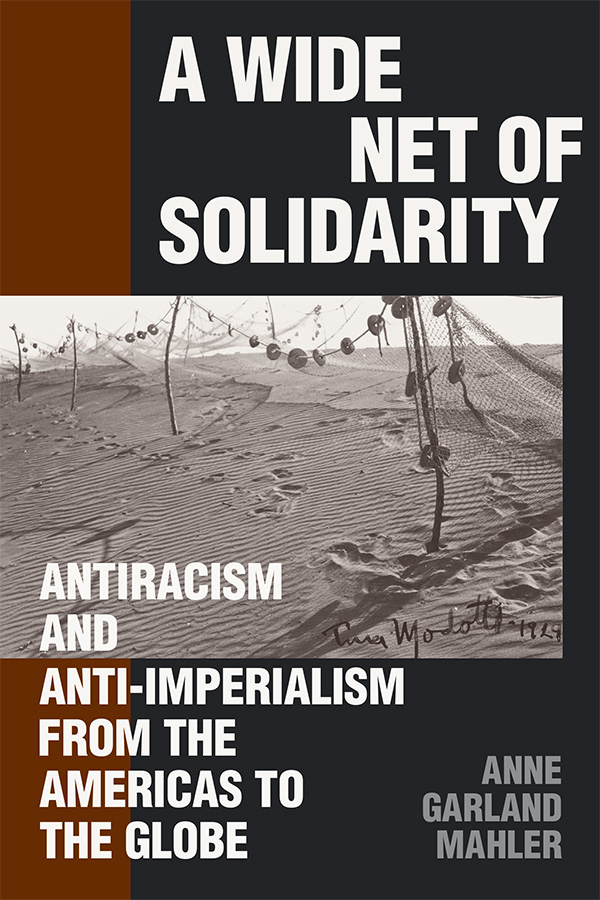
Another highly-anticipated and important book that we have recently indexed at Southwest Humanities is Anne Garland Mahler’s A Wide Net of Solidarity: Anti-Racism and Anti-Imperialism from the Americas to the Globe (Duke University Press, 2025), which was recently published. In A Wide Net of Solidarity, Mahler uncovers the remarkable history of the Anti-Imperialist League of the Americas (LADLA), founded in Mexico City in 1925, as a pioneering transnational network of resistance. Spanning fourteen chapters across the Americas—especially active in the Caribbean and the United States—LADLA united trade unions, agrarian groups, and artists. Their participation in the 1927 Brussels Congress, alongside leaders from Africa, Asia, and US Black activists, highlights their global reach and the hemispheric ambitions of their movement. Mahler draws on extensive archival work to reveal how LADLA brought together Black, Indigenous, and immigrant-led struggles, offering a multiracial critique of capitalist exploitation while centering solidarity across differences. Her expansive vision—blending antiracist and anti-extractive politics—foreshadows today’s social movements striving for economic and racial justice in a global context. A Wide Net of Solidarity revives a forgotten yet powerful legacy of antiracist and anti-imperialist organizing. It is essential reading for scholars and activists alike, offering profound lessons on how international cooperation and intersectional solidarity can challenge entrenched systems of exploitation. For more information, please see the publisher’s website here.
 SOUTHWEST HUMANITIES