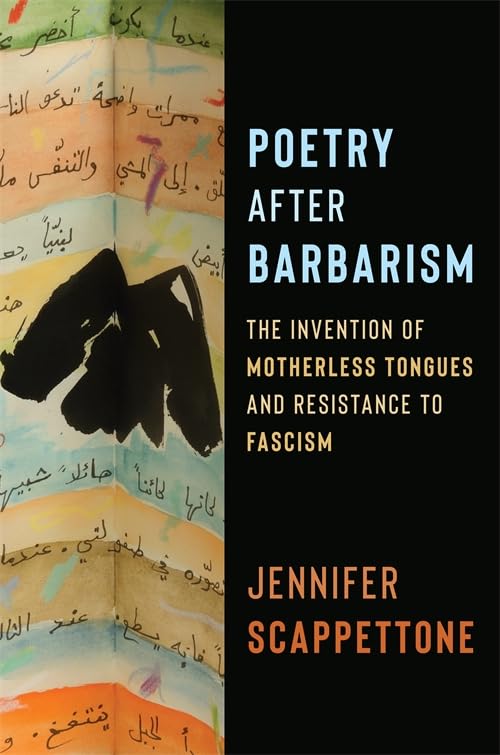
One of the most theoretically complex, intense, and far-reaching books we have ever indexed at Southwest Humanities is Jennifer Scappettone’s new work, Poetry After Barbarism: The Invention of Motherless Tongues and resistance to Fascism (Columbia University Press, 2025), which is now available. Poetry After Barbarism investigates how writers, especially those displaced, stateless, or otherwise marginalized, develop what Scappettone calls “xenoglossic” poetics—poetry that emerges in between languages, beyond (or outside) established national tongues. Rather than writing in a language one is born into or granted by citizenship, these poets write in what the author calls “motherless tongues,” engaging with linguistic borders, mixing and fragmenting idioms in acts of resistance. Scappettone situates this work against the backdrop of rising fascism, xenophobia, and ethno-nationalist rhetoric that valorizes linguistic purity. She studies poets like Baroness Elsa von Freytag-Loringhoven, Amelia Rosselli, Etel Adnan, LaTasha N. Nevada Diggs, Sawako Nakayasu, among others, exploring how their experimental multilingualism, border-crossing forms, and radical mistrust of belonging become potent tools for resisting exclusionary politics. Through exhaustive analysis and interpretative acuity, Scappettone’s Poetry After Barbarism threads together poetics, political history, and resistance to dominant norms of language and belonging. This is an important book for scholars and readers of poetry, poetics, art history, and literary theory. Please see the publisher’s website here for more information.
 SOUTHWEST HUMANITIES